
A biostimulant strip trial is the most direct way to find out whether a biostimulant works well on your land, with your crop. Based on your own harvest figures, not on what we promise or what a colleague swears by.
It works like this: on one field, you treat a strip with biostimulants and leave the strip beside it as it is. Everything else stays identical — fertilisation, variety, sowing date, crop protection — except for the biostimulant you’re testing. After harvest, you compare the two strips.
But to get a fair comparison, there are a few things you need to get right. Agro-Solutions can help with all of it, from picking the right field to making sense of your harvest results.
Here’s how to set up a biostimulant strip trial, step by step.
Pick a field where you have at least a few years of yield data. That way, after harvest, you’ve got something to measure against.
A few other things worth considering:
The treated strip runs the full length of the field, at least one sprayer width wide. That way you can easily keep the treated and untreated strips apart, during application and at harvest.
The basic rule: everything between the two strips must be identical, except for the biostimulant. That means:
Mark the boundary between the strips clearly — stakes or pegs work well — so you know exactly where the split is when harvest comes around.
Get in touch before you start. We’ll talk through which product fits your crop and situation, and work out an application schedule.
Before the first biostimulant application, write down what you’re starting with. That gives you a fair point of comparison when the results come in after harvest.
What to write down:
A few lines in a notebook or on your phone is all it takes.
When we set up the strip trial with you, we’ll agree on when to take measurements. The timing depends on the crop and the season.
Each time you check, note down:
Take a photo of both strips at each check. Same spot, same time. That way you can lay them side by side later and see what’s changed.
Keep the treated and untreated strips separate at harvest and weigh them separately. How you make that work in practice — through your contractor or your own weighbridge — is something we’ll sort out with you beforehand.
For each strip, write down:
With those numbers, you can work out for yourself what the difference was worth, based on your own yield, your own grading, and your own price.
One season gives you a first read. If the results stack up, the next step is to roll it out across more of your land.
Here’s what our biostimulants have done in trials.
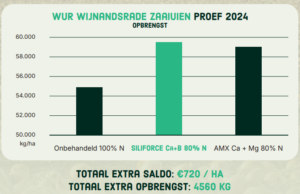
Onions, WUR Wijnandsrade 2024
Siliforce Ca+B reached approximately 59,500 kg/ha with a reduced nitrogen application — 80% of the standard rate. The untreated strip at the full nitrogen rate came in at around 54,800 kg/ha. Extra return: €720/ha.
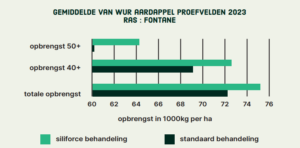
Potatoes, WUR trial fields 2023 (variety Fontane)
In trials run by WUR, Delphy, and SPNA, Siliforce produced a higher total yield and shifted a larger share of the crop into the 40+ and 50+ size grades. Those are the sizes that get you the better price.
These are our numbers. What will yours be?
Agro-Solutions can help you set up a strip trial from start to finish: from choosing the right field to reading your harvest results. We come to you, take a proper look at what you’re working with, and put a plan together.
Give us a call or drop us an email, and we’ll set up a visit:
+31455778761
contact@agro-solutions.nl